
When security and digital independence are non-negotiable, shared satellite networks should not be an option.
Astranis MicroGEO satellites are small, powerful satellites that can be manufactured quickly and launched into high orbit faster than ever, resulting in a faster go-to-market time with complete control over connectivity, data, and the digital future.
No shared capacity. No foreign dependencies. No compromise.

stc group configures the payload and decides where coverage goes.
Traffic stays sovereign in the Kingdom under enterprise-grade security.
Built for rapid deployment on Astranis Block 3, launching soon.


.png)





Astranis MicroGEO satellites turn sovereignty into control built into our architecture: dedicated capacity another tenant cannot erode, routing and data that stay inside the border, and authority over the policy and the keys.
The world's first MicroGEO was Arcturus, a Ka-band communications satellite. All Astranis-designed hardware continues to operate in orbit, where the satellite continues to complete missions for commercial and defense customers. Three more Prime satellites have already launched, serving our partners across the globe, from the Philippines to the United States.
%20(1).png)
%20(1).png)
Omega is a broadband communications system with better pound-for-pound performance than any other geostationary satellite in orbit today. It will offer dedicated bandwidth, uncontended throughput per satellite while maintaining Astranis’s MicroGEO, small satellite form factor.
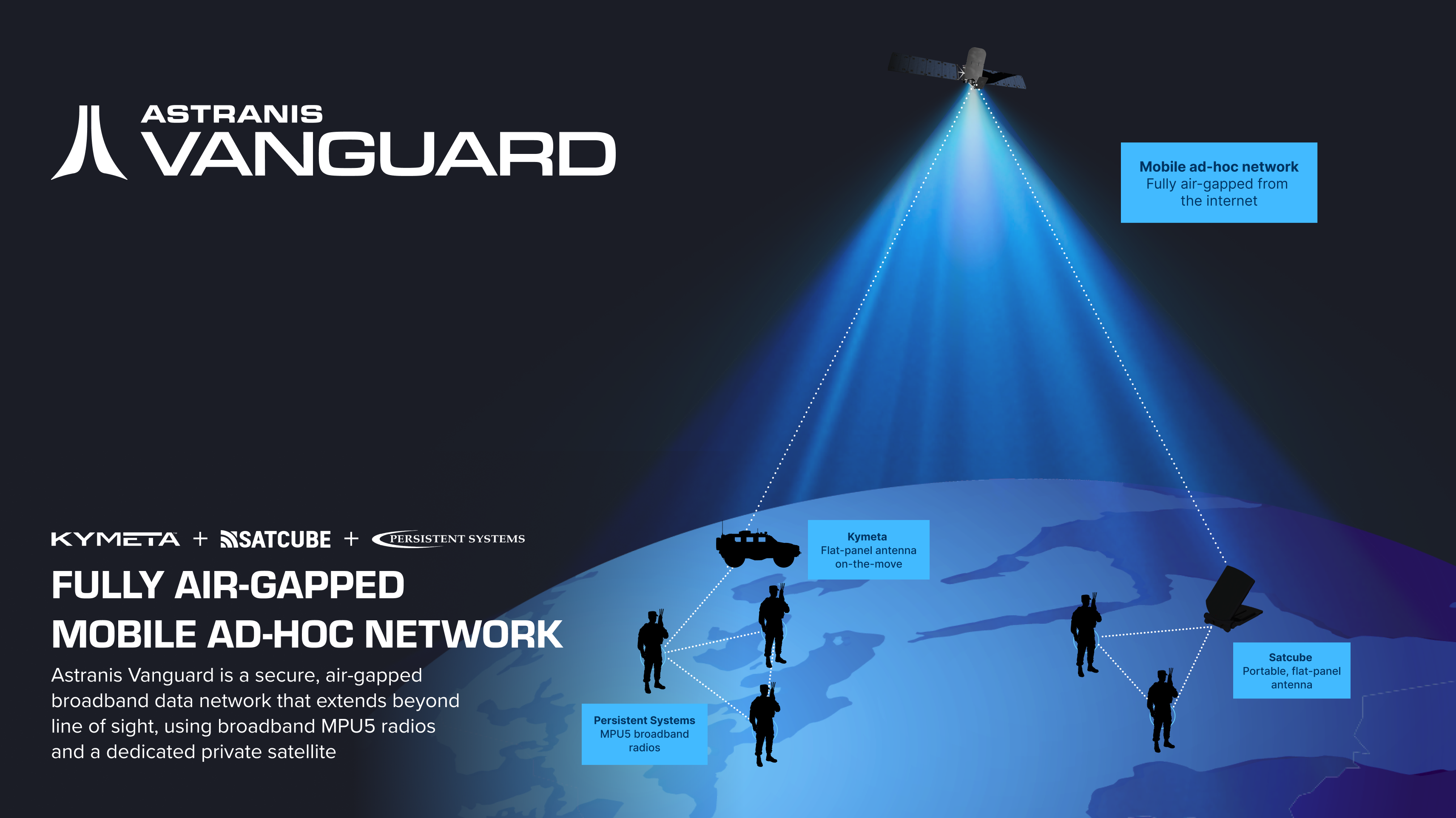
A fully air-gapped, rapidly deployable network using a dedicated satellite. In partnership with Persistent Systems, Kymeta, and Satcube. And we’ve demonstrated this capability using an operational, on-orbit satellite asset. Astranis Vanguard offers both defense and commercial customers the ability to quickly and easily spin up a resilient, self‑forming network capable of voice, video, and broadband data.

We have already relocated our satellites multiple times, and are fueled for many more years of continued operation.

Our proprietary SDR allows us to reallocate bandwidth and power on the fly, across 9 GHz of simultaneous bandwidth.

Astranis-designed hardware has already weathered multiple solar storms in space, without issue.
Does your traffic and data stay inside the border?
Can another tenant erode the capacity you rely on?
Who decides priorities when demand surges?
Who controls where capacity points and how it is split?
Who holds the keys to the network?

